Tradition-filled heritage
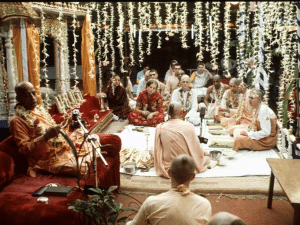
Visakha Devi Dasi: On the cold gray morning of November 29, 1971, two couples married: Mani-bandha and Kanta, recently arrived from America, and Yadubara and his girlfriend, Jean. Jean was also initiated.
Did Jean remember that only five weeks earlier she was prepared to leave asrama life for good? No, not really. Although her faith was dim and pliable, she was propelled by the euphoric impetuousness of youth. Did she grasp the tradition and culture she was entering? Vaguely. Jean was caught up by the place, by the circumstances, and by Prabhupada. Did she consider entering other religious traditions more natural to her upbringing? To her, the path mattered less than the guide. She'd found a guide. This was a singular moment, a silent sounding of inconceivability.
Before handing me my japa beads, Prabhupada asked, “What are the rules and regulations?”
“No eating of meat, fish or eggs, no taking of intoxicants, no gambling and no illicit sex,” I said.
Four simple no's—but how revolutionary! This rare standard separated Prabhupada’s movement from almost every other organization on earth. Had I stumbled into something crazily depriving? Or was it authentic? Something that would disappoint me or benefit me? Was | following my head or my heart? Or neither? Or both? It was dizzying.
I realized that observing the four prohibitions Prabhupada requested of all his students could avert untold suffering—the adverse health and ecological effects of meat-eating, the wasteland of addiction, the emotional damage of sex out of wedlock. My thoughts were simplistic: “Why blur the senses, why cloud the mind, why be lust’s lackey when just by abstaining I can attain God?” With uncharacteristic optimism, I skirted the seriousness of these lifelong vows and the struggle inherent in bucking the entire thrust of modern life and plunged in. I would compete in the greatest of all contests: the inner frontier, the struggle against lust and greed. I would define myself against the temptations of an age.
Flushed with the beauty and consistency of Krishna consciousness, with the promise and potency of Prabhupada’s presence in my life, I had unstoppable hope—I could, I would follow these rules and regulations for the rest of my life. Krishna, irresistible Krishna, was Prabhupada’s. Prabhupada had the power to give him to me.
I accepted my vow to chant the maha-mantra with the same easy optimism. Prabhupada, solemn, looked directly at me, his eyes as deep as a woodland pond. Full of guileless wisdom, those eyes that knew the secret of a rich culture penetrated the many layers covering me. I wondered what he saw in me and wished it was better; but anyhow, he was accepting me.
Although he already had hundreds of disciples, at that moment it was just him and me. A long-lost individual was making a momentous, fateful promise. My soul glowed, my heart trembled.
“And how many rounds of japa will you chant each day?”
Nervous yet confident, I said, “16.”
With that same direct look, Prabhupada said, “That is the minimum," and handed me my shiny, dark brown, smooth beads made from the holy tulasi tree from the holiest land of Vrindavana, the place where Prabhupada had once directed us and where my spiritual journey had begun.
As Prabhupada watched, Gurudasa performed the marriage ceremony, intoning Sanskrit mantras and pouring clarified butter over a small fire in a two-foot square, sand-filled box. As part of the ceremony I put drops of water on my right palm, and the red mehndi lines Malati had drawn on my hand (a traditional art, but Malati hadn’t used the traditional water-resistant henna dyes) started to run. Redwater ran through my fingers, onto my wedding sari and spread into a six-inch Rorschach inkblot over my knee. I thought my knee had somehow started bleeding. Malati ran for a cloth, I dried my hands and swabbed the mess. Expressionless and without comment, Prabhupada solemnly observed.
Gurudasa concluded with a talk on the relationship between husband and wife, saying that the husband was duty-bound to protect his wife. Hearing this, I squirmed inside. To me, “protection” sounded like a bedfellow to “restriction” and “repression.” What was I getting myself into with this marriage?
But it was as if Gurudasa heard my qualms. He went on to say that protection was not suppression. It was not stifling growth, as with a topiary, but freedom from disturbance so a woman could grow without hindrance. A protected woman was loved, honored, championed, cherished, and motivated to offer service to God according to her unique ability.
“I dunno about this,” I thought. “But I guess dad protected mom. He paid for our apartment, food, clothing. He gave mom the space to do things she loved to do” I sighed, relieved by the thought. Then it got worse again.
Gurudasa continued, saying that the wife was subordinate to her husband. “Oh, no! Where’s he going with this one?” I thought.
He explained that beneath its surface, women’s subordination held weighty implications. As a source of inspiration to men, her subordination was a wellspring of strength where the inspirer was more powerful than the inspired. Gurudasa quoted Prabhupada, saying, women are accepted as a power of inspiration for men. As such, women are more powerful than men.
I wasn’t interested in power and wasn't sure about a wife's position in a Krishna conscious marriage, but my trepidation lessened. I understood that marriage was a complex dance between two individuals and for Yadubara and me to learn the Krishna conscious steps to that dance would take some time. For now, at least, a successful marriage seemed doable and even an exciting way to offer service to Krishna.
We then threw whole, unpeeled bananas onto the fire, signaling the end of the ceremony, and kirtana started. The end of Yadubara’s shoulder wrap and the end of my sari were ceremonially tied together, and we joined everyone else in circumambulating the altar, which housed the small brass Radha Krishna Deities Yadubara had bought at Yamuna's request when we were in Vrindavana five months earlier. Smoke rose from the fire, the kirtana beat picked up, and Prabhupada stepped into his room. Sitting relaxed, he observed us through his open door. As I jumped and clapped and sang with abandon under his gaze, I felt my lingering reservations and old perceptions and the rationality that had previously directed my worldview all slip away. I was investing in my heart and mind wholly in spirituality. I felt unbelievably present.
Now with the spiritual name Prabhupada had given me, Visakha Devi Dasi, servant of one of Krishna’s Vrindavana companions, | had officially entered an unknown frontier with a leader who knew the tricky terrain. To do anything else, to go anywhere else with anyone else was unthinkable. Something inside me that had begun to yawn and stretch and twist since I'd arrived in India had become unshackled. Unabashed hope was dawning in my heart. I felt sheltered. I was completely alive and burned with desire for more life. The toxic vacuum of atheism no longer sucked all the special value from me and from how I viewed other beings. The universe was no longer awash in purposelessness. For the first time in my life I was completely happy. I was so happy I felt nothing could or ever would cloud my happiness. I was now Prabhupada’s spiritual daughter. No one and nothing could ever break that relationship.
My feelings were so varied and intense I couldn't really deal with them. I was embracing all the glee, all the wonder that resided in everything. I looked at everyone present and they were beautiful. The blazing sacred fire filled my eyes with tears. Deep inside me gates were opening, one by one, revealing a vital area I couldn't afford not to reveal; releasing my love for that irresistible person within yet well beyond my reach.
Not one family member or relative had attended my initiation-marriage, and except for Yadubara, no one from my school days. The only guests present were those who happened to be there—we hadn't invited anyone. Yet I missed no one. I had stepped out of my past so completely that I hadn't even informed those who'd been in it. Neither did I think of my future. The present filled my existence, and I wanted nothing but more of it of Prabhupada, of the reality he presented, of the culture he propounded.
Now that I was not Jean but Visakha, not single but wedded, a flood of paradoxes floated through me—I was bound to vows, mostly ones contradictory to my upbringing—and I was suddenly afraid of the karmic consequences of breaking those vows, plus I never wanted to shame myself before Prabhupada and his students. But mostly I was thrilled by the possibility of spiritualizing myself and my life, although I wasn't particularly clear what spiritualizing meant.
Meanwhile, there was Prabhupada, so elderly and wise yet so fresh and youthfully innocent. Excited by Krishna and exciting us about him. Steady yet unpredictable. I was so infused and ignited with the hope that I overlooked the magnitude of my goal. Commune with God himself? Become a godly person? Me? Yeah, sure. Yet Prabhupada said we could—I could—do just that. It seemed impossible, unrealistic, pie-in-the-sky, but I believed him (why? because he was believable) and became filled with enthusiasm.
If I could do this immense thing—become closer to God—how could I do it? The only possible way was to come closer to Prabhupada, the person who made the promise, who was telling me how to get there, who knew so much and was so earnestly giving me what he knew, who didn’t seem to falter in his God-conscious mission and behavior. Galvanized by the possibilities Prabhupada confidently placed before me, I wanted to take every opportunity to hear him, and when | couldn't do that, be ever eager to hear about what he was saying and doing. Gone were my aspirations to be a world-famous photojournalist. Prabhupada would now be the subject of my photographs. In a sense I wanted to be subsumed by him, not to lose myself, but to find myself, my centering, my identity. I wanted to be one in purpose with Prabhupada.
Both my parents had rejected religious ritual as meaningless; under Prabhupada’s tutelage, I embraced it as a window to reality. They had both abruptly left their tradition-filled heritage; just as abruptly, I left the tradition-less heritage they'd bequeathed me.