Our life maybe one day successful
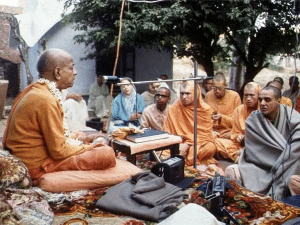
Visakha Devi Dasi: Srila Prabhupada decided to speak on the Srimad-Bhagavatam’s First Canto, second chapter, “Divinity and Divine Service," starting with text 5: “O sages, I have been justly questioned by you. Your questions are worthy because they relate to Lord Krishna and so are of relevance to the world’s welfare. Only questions of this sort are capable of completely satisfying the self.”
As we listened, pilgrims wrapped in plaid wool chaddars circumambulated the temple grounds and us as well, occasionally ornamenting Prabhupada's words with a mellow “jaya radhe.” Monkeys in the area bickered, flocks of birds in the dense branches overhead twittered, and the words of Srimad-Bhagavatam entered my ears, replenishing pools and freshets of faith in transcendence—simple faith that had begun as an experiment and which I now wanted to experience more fully and to make more fixed.
Prabhupada said: “So Srila Rupa Gosvami, in front of whom we are now speaking, he gave us the definition of how one can make progress in spiritual life.”
Just before coming to Vrindavana, I'd read some of Rupa Gosvami’s many instructions for spiritual progress, among them to “reside in a holy place like Vrindavana.” That, I thought, was Prabhupada’s first instruction to me: “Best that you go to Vrindavana.” My life had not been the same since, which was, to me, a testimony to the validity and potency of Rupa Gosvami's words.
Prabhupada continued, “Everyone is blind after the material way of life. So the mission of human life is to get out of these clutches of maya [illusion]. That is the real mission of life. We are missing the point. We are accepting this body as everything. And modern civilization means to enjoy bodily comforts as much as possible. That is the perfection of civilization. No. That is not the perfection of civilization”
“My God,...” I thought, “...practically everyone in the world has gone astray!” Then, soberingly, I realized, I’m part of the problem - I like comfort and pleasure as much as the next person. Yet at the same time, I could feel my desires and goals shifting. I was valuing simplicity as something helpful for Yadubara’s and my lives together. Waste of any sort was becoming distasteful and disturbing. I was beginning to look askance at what was labeled modern “progress.” I could clearly see how the existence of cars, for example, was questionable progress. By using cars people were, no doubt, getting to their destinations faster than they had by horse or bullock or on foot, but car exhaust fumes had poisoned the air in Delhi and many other cities. City traffic jams were notorious, traffic noise was disturbingly loud more or less everywhere, parking was a nightmare, horrible car accidents were prolific and, on top of all that, hundreds of thousands of people were stressed by the heavy costs of owning, maintaining, and driving their cars. Plus, how many miles of rich earth had been covered with asphalt to accommodate traffic? How many people suffered to manufacture these cars? To sell them? To repair them? This was progress?
I found I loved Prabhupada’s logic and pragmatism and how he made everything relevant and easy to understand.
He continued, “Here, in this very sacred place, all the Gosvamis used to study Bhagavatam under the leadership of Rupa Gosvami and his elder brother, Sanatana Gosvami. This is the most important place in the world. So, you have got this opportunity. At least for a few days, let us sit down here and under the protection of Srila Rupa Gosvami and Jiva Gosvami, we are not going to imitate them, but we want a place under the shelter of their lotus feet to discuss something of their contribution. Then our life maybe one day successful.”
To me, success was having a good relationship with Yadubara and the other devotees. It meant doing my photography service well, and it meant that I and my photography were being recognized and appreciated by Prabhupada and his followers. To be an anonymous, unknown face among a mass of devotee's faces was not, to me, success.
“Honestly...” I thought, “...I’ve given up a desire for success and recognition in the photojournalistic world for a desire for success and recognition in the smaller devotee world. What kind of devotee am I, anyway?”
Prabhupada’s teachings surged and throbbed ceaselessly against my old, barnacled mindset like ocean waves pounding a concrete pier. I accepted his teachings to some degree, but I kept to my old ways. Then I accepted them again but kept to my old ways. Again and yet again. Still, the more I listened, the softer I felt myself becoming; I was slightly less ready to criticize myself and the other devotees, slightly more ready to try to grasp and apply what he was saying.