His search for life's meaning led to Krishna
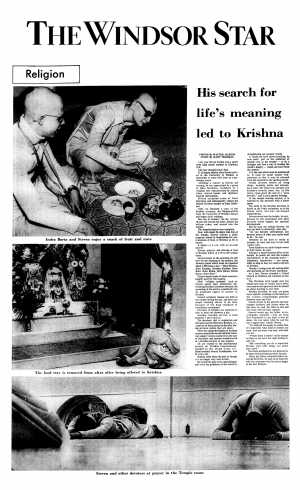
This article, "His search for life's meaning led to Krishna," was published in The Windsor Star, March 3, 1973, in Windsor, Canada.
PHOTOS By WALTER JACKSON
STORY By MARY TRUEMAN
Last year Steven Forbes was a small-town high school student in Chatham, N.B.
Life has changed since then.
It all began shortly after Steven arrived at the University of Windsor in September to enter first year as a psychology major.
Attending a concert in Detroit one evening, he was approached by a group of Hare Krishnas, members of a religious sect characterized by saffron robes, shaved heads, and rhythmic musical instruments.
Steven accepted some of their literature and subsequently visited the Detroit Krishna temple on East Jefferson.
Next, he obtained a copy of the Krishna scripture, the Bhagavad-Gita from the University of Windsor library and began daily readings.
One day in January, the shy, serious 18-year-old shaved his head, donned the saffron robes, and moved into the temple.
The transformation was complete.
Now, with about 25 others who live at the temple, Steven follows a daily program aimed at heightening his consciousness of God, or Krishna as He is known.
It begins at 4 a.m. with an ice-cold shower.
Hymns, prayers, and offering of food to Krishna follow at 4:30 in the temple room.
Several hours of the morning are left free for the chanting of the mantra, the 16-word praise which must be repeated about 1,700 times a day: "Hare Krishna, Hare Krishna, Krishna Krishna, Hare Hare. Hare Rama, Hare Rama, Rama Rama, Hare Hare."
Prayer beads made of tulasi wood are usually used for the mantra.
Most "celibate students" such as Steven spend their afternoons distributing Krishna literature because the spreading of the word is considered to be an important aspect of service to Krishna.
Several scripture classes are held at the temple during the day, and there are ample cleaning chores to be done because of the high standard of cleanliness maintained.
Devotees of Krishna are expected to take at least two showers a day.
Another worship service is held between 7 and 7:45 p.m.
The devotees' diet is vegetarian and all foods must be offered to Krishna, i.e., a portion of them placed on his altar during services, before they are eaten.
There are about 80 temples or Krishna centres around the world and their financial support comes mainly from the sale of literature and incense manufactured at a Krishna factory in Los Angeles.
All are related to the International Society for Krishna Consciousness, founded by His Divine Grace A. C. Bhaktivedanta Swami Prabhupada, now 76 years old.
Stephen talks about the past as though it is no longer very real to him.
He recalls his plan to be a psychologist and solve the problems of the world by straightening out peoples' minds.
It would not have solved anything, he now feels, just as the ambition of another boy at the temple - to be a biologist and find a way of feeding the world's hungry - would not have been the answer.
It is the soul which must be ministered to. It must be made totally God-conscious so that it may be released from the material to the spiritual world.
Krishna devotees believe all living things, including plants and animals, have souls. The tulasi tree, because it is Krishna's favorite plant, has, by His mercy, been given the soul of a "pure devotee," and is paid special homage.
In the temple worship service, it is watered by the devotees with a silver spoon.
The faith of the Krishna devotees is based on the Vedic scriptures, as is the Hindu faith, but has developed independently.
Steven moved into the temple, he says, because he felt association with other devotees would support his spiritual development.
But he may not remain forever; he may go back to university some day.
"As you become self-realized, you become aware of what you really want to do," he said.
Devotees do not have to reside in temples, he said, and may in fact hold regular jobs.
Some families set aside temple rooms in their home, he said.
Sitting in a small business office in the temple, he points out that the modern conveniences of the material world - telephones, typewriters - are acceptable so long as they are used in service of Krishna.
Nearby a young man sits sorting bills and operating an electronic calculator.
As a boy, Steven attended a United Church in Chatham but retained no ties to it.
The Christian faith taught that you should love God, he recalls, but it never conveyed to him precisely how he should go about learning to love Him.
Krishna devotees, he said, are given more specific teachings on the nature of the various relationships possible between man and God.
Steven writes to his parents and four younger brothers and sisters when he has time, he said, but there is less and less time with his busy agenda.
Several weeks ago, his father, an encyclopedia salesman, came up from New Brunswick to see what it was all about. He was upset when he saw his son's appearance. admits Steven.
"It's difficult for people to realize that it's important what kind of clothes you wear, how you wear your hair, and what you eat."
"People think it doesn't really matter as long as you have the right feeling inside you."
"But everything you do is important because even little things can affect your spirit."
The dress and hairstyle are believed to be those which Krishna prefers, he said.
While his father remained rather unconvinced of this, he said, he at least left with the assurance that his son is happy in his new lifestyle.
Photo 1: Indra Barta and Steven enjoy a snack of fruit and nuts
Photo 2: The food tray is removed from altar after being offered to Krishna
Photo 3: Steven and other devotees at prayer in the Temple room